- Lokales Ranking
- Google Maps
- Local SEO
- Google Bewertungen
Local Google Ranking: Relevance, Distance and Prominence
Why does a competitor appear above your business even though they are only two streets away? Google identifies three central factors behind local search results: relevance, distance and prominence. Here is what they mean, how reviews fit in and what you can improve over the next 90 days.
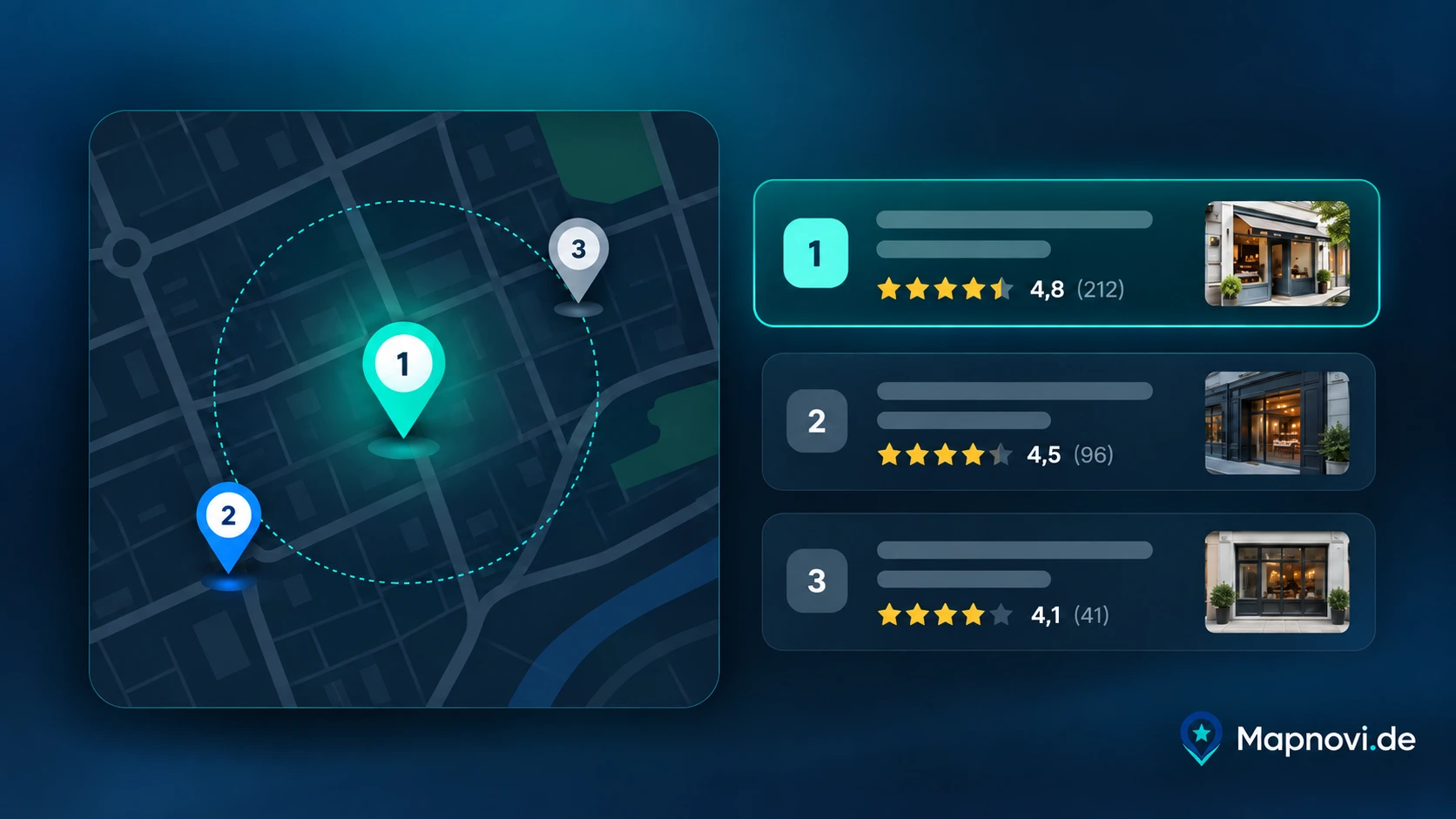
You search Google for your own type of business and find a competitor listed above you.
Their location may only be two streets away. Their website does not appear better. At first glance, their Google Business Profile does not seem particularly remarkable either.
So why are they ranking higher?
Google does not disclose the exact weighting of its algorithm. It does, however, explain the foundations of local ranking. Three factors are particularly important: relevance, distance and prominence.
These factors work together. A business that is farther away can still appear above a closer competitor if Google considers it the better overall match for the search.
You have very little control over distance. Relevance and prominence, however, are areas businesses can actively improve.
The three factors behind local Google rankings
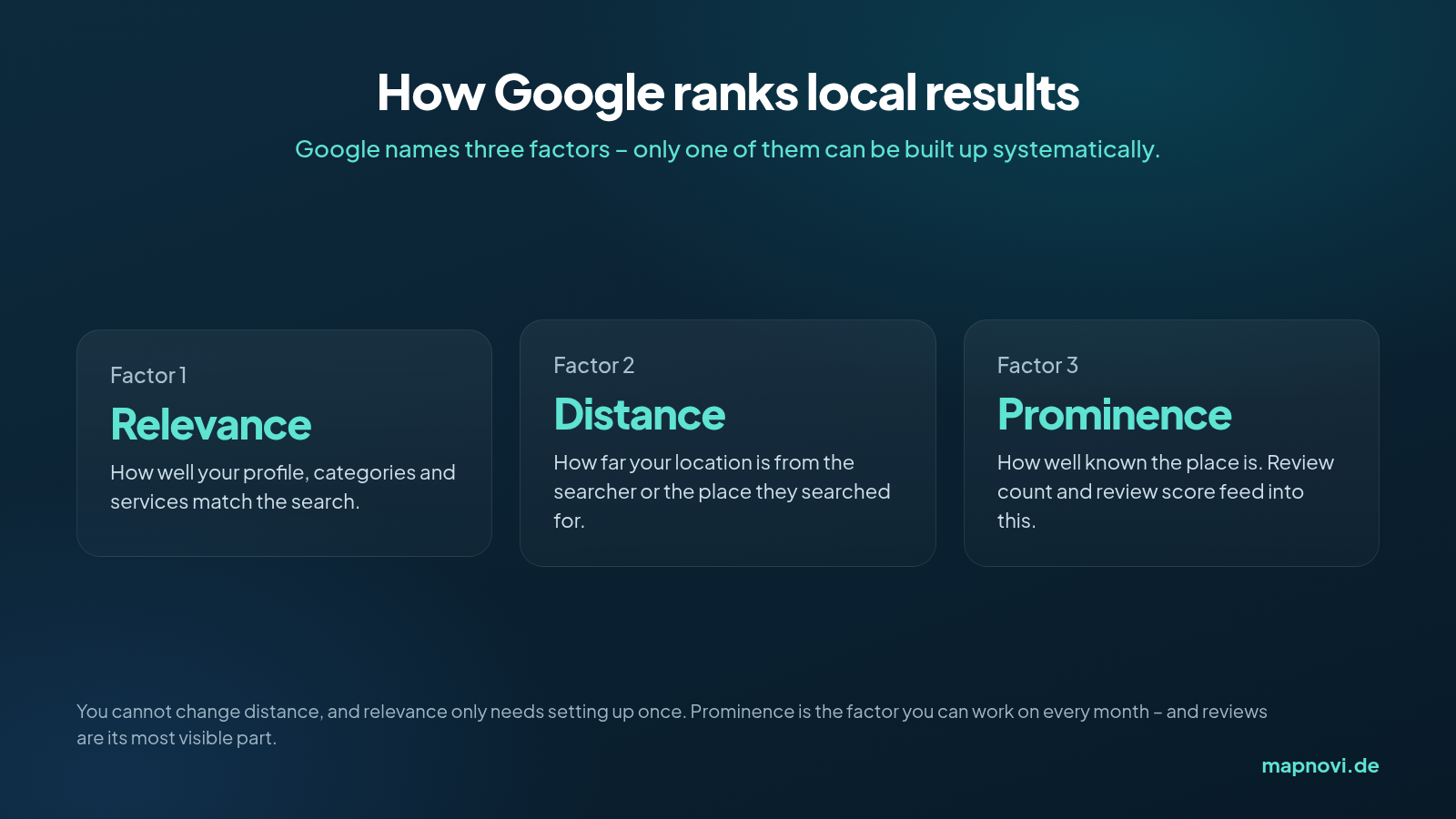
In simple terms, Google describes the three factors like this:
Relevance describes how closely your business matches what someone is searching for.
Distance considers how far your business is from the searcher or from the place specified in the search.
Prominence describes how well known and established a business appears to Google.
This simple framework already explains much of why local search results can differ between locations and businesses.
Relevance: Does Google understand what you offer?
Relevance describes how closely your Business Profile matches a particular search.
If someone searches for "dentist implants Cologne", Google first needs to understand which practices are relevant to that service and location.
Businesses can make this easier by keeping their profiles complete and accurate.
Important areas include:
a primary category that accurately describes the core business
appropriate additional categories for genuine business activities
complete services and products
accurate opening hours, address and contact information
relevant attributes
a clear business description
The goal is not to fit as many search terms as possible into the profile.
A bakery does not become more relevant simply because the word "bakery" appears five times in its description. What matters is that Google and potential customers can clearly understand what the business actually offers.
Our Google Business Profile checklist explains how to review these areas systematically.
Distance: Why there is no permanent number 1
Distance is the factor businesses have the least control over.
Google considers how far a potential result is from the person searching. If a particular place is included in the search query, Google can take that location into account as well.
This has an important consequence: There is no single permanent number 1 position in local search.
A dental practice may appear near the top for the same query in one part of a city and considerably lower a few kilometres away.
Statements such as "We rank number 1 on Google" therefore have limited meaning in local search unless you also know where the search was made and which exact query was used.
Distance itself cannot be changed through SEO.
What you can improve are the other two areas. The more clearly Google understands your offering and the stronger your business's prominence becomes, the better your overall foundation for competing locally.
Prominence: What does Google know about your business?
Prominence describes how well known or established a business or place appears to be.
Google does not only consider the Business Profile itself. Information from across the web can also contribute, including mentions, links from other websites, business directories and other publicly available information about a company.
One point is particularly important for local businesses:
Google explicitly mentions review count and positive ratings in connection with prominence.
Reviews therefore perform two different roles.
They help potential customers evaluate a business. At the same time, they can contribute to the signals Google uses when assessing how prominent a business is.
Google does not publish the precise weighting of those signals. Ten new reviews therefore do not automatically mean moving ten positions higher.
What reviews actually influence
Reviews are often discussed as though they were one single ranking factor. In reality, different aspects have different effects.
AreaWhat it meansNumber of reviewsGoogle explicitly mentions review count in connection with prominence. A larger review base also makes the average rating more stable.Average star ratingGoogle says positive ratings can contribute to local ranking. The average score is also immediately visible to potential customers.RecencyRecent reviews give customers a current impression of a business. Google does not identify review recency as a separate main local ranking factor.Business responsesReplies do not change the average rating, but they can demonstrate that feedback is noticed and handled professionally.
The size of the existing review profile is particularly easy to underestimate.
If a business has only 20 reviews, one additional 1-star rating can noticeably change the visible average. With 500 reviews, the same single rating has a much smaller mathematical effect.
The smaller the review profile, the more strongly an extreme rating can affect the overall impression.
How problematic reviews relate to local visibility
One negative review does not automatically cause a business to fall in local rankings.
The algorithm is not that simple.
Google does, however, state that reviews and positive ratings can contribute to prominence. Every new rating also affects the publicly visible average on the profile.
It is therefore important to distinguish between legitimate criticism and a possible policy violation.
A genuine customer is allowed to describe a negative experience. A review cannot be removed simply because it harms the business.
The situation is different when there are specific indications that a review may violate Google's policies. This may be relevant, for example, when no genuine interaction is known or other prohibited content may be involved.
In those cases, the review can be submitted for assessment. Google decides whether any action should be taken.
Found reviews you cannot associate with a genuine interaction?
With Mapnovi, you can submit publicly visible Google reviews from your Business Profile for assessment.
Mapnovi handles the technical and administrative submission and tracking. Google reviews the case and decides whether any action should be taken.
0 euros upfront. No base fee. No subscription. Success-based billing.
Why a single ranking position tells only part of the story
With traditional search results, people are used to comparing individual positions.
Local search is more complicated.
The businesses a user sees can depend on their location, the exact search query and the way local results are presented in Google Search or Google Maps.
The goal of local optimization should therefore not be to appear in first place for every user and every search.
A more useful objective is to appear consistently for relevant searches within the areas your real customers come from and then create enough trust to turn that visibility into action.
Even a strong ranking has limited value if opening hours are incorrect, important services are missing, the phone number does not work or a competitor's profile creates a significantly better first impression.
Local ranking creates attention. The Business Profile then has to turn that attention into a visit, a call or an enquiry.
What you can improve over the next 90 days
Local optimization does not need to become a daily SEO project.
A structured 90-day plan gives you enough time to create a solid foundation and then determine whether the metrics that matter are actually moving in the right direction.
Days 1 to 7: Record your starting point
Before making changes, document the current state of your profile.
Depending on the data available, record:
number of reviews
average star rating
profile views
important search queries
direction requests
call clicks
website clicks
You can also record several important local searches. Do not treat individual ranking positions as absolute, however. A search made from a different location can produce different results.
Days 8 to 30: Improve relevance
Review your entire Google Business Profile.
Check your primary category, additional categories, services, products, attributes, opening hours, phone number, website, address and photos.
Remove outdated information and add anything potential customers genuinely need.
The goal is not to put as much content as possible into the profile. Google and a potential customer should simply be able to understand quickly what your business offers and whether it matches the search.
Days 31 to 60: Build a compliant review process
Regularly invite genuine customers to leave honest feedback.
Google provides a direct review link that can also be shared through a QR code.
Three basic rules are important:
Do not offer incentives for reviews.
Do not tell customers which star rating to leave.
Do not selectively approach only customers you expect to leave positive reviews.
A good review process collects genuine experiences. It does not manufacture a desired rating.
Our guide on how to improve your Google Maps rating explains how to build that process.
Days 61 to 90: Strengthen prominence
During the final stage, look beyond the Business Profile itself.
Check whether your company information is accurate in important business directories, whether outdated details remain elsewhere on the web and whether your business is mentioned on relevant local or industry websites.
Existing reviews should be part of this review as well.
Legitimate criticism can provide useful feedback. When there are specific indications that a review may violate Google's policies, it can be submitted for assessment.
After 90 days: Look beyond the star rating
After three months, compare the new figures with your original baseline.
Do not focus only on the average star rating.
The overall picture is more useful:
Are relevant profile views increasing?
Are users finding the business through more appropriate search queries?
Are calls increasing?
Are more people requesting directions?
Are website clicks increasing?
Is the number of genuine reviews growing?
A Business Profile can become more effective even if its visible average rating barely changes.
Seasonality should also be considered. Comparing a restaurant's December directly with August, for example, can produce misleading conclusions.
What not to do for better rankings
Local SEO is not an area where more automatically means better.
Adding keywords to the business name, selecting irrelevant categories, buying reviews or creating fake locations are not sustainable optimization methods.
Google states that a better local ranking cannot simply be requested or purchased.
Be cautious with promises such as "Guaranteed number 1 on Google Maps".
Strong local visibility does not come from one shortcut. It comes from accurate information, genuine relevance, growing prominence and a credible reputation.
Conclusion
There is no single switch that determines local Google ranking.
Google combines relevance, distance and prominence.
You have little control over the distance between your business and an individual searcher. The other two factors are different.
A complete and accurate Business Profile helps Google match your offering with relevant searches. A stronger presence across the web, genuine reviews and positive ratings can also contribute to prominence.
Those are the areas worth improving.
Not through short-term tricks, but through a profile that clearly explains what you offer, a compliant review process and regular measurement of the results.
Found potentially problematic reviews while reviewing your profile?
If you cannot associate a review with a genuine customer, business, employment or application interaction, or there are other specific indications of a policy violation, you can submit it for assessment through Mapnovi.
You select the review. Mapnovi handles the technical and administrative submission and tracking. Google reviews the case and decides.
0 euros upfront. No base fee. No subscription. Success-based billing.
Updated on 16 October 2026